BIM for Sheet Metal Fabrication: The 2026 Guide to Digital-to-Physical Workflows

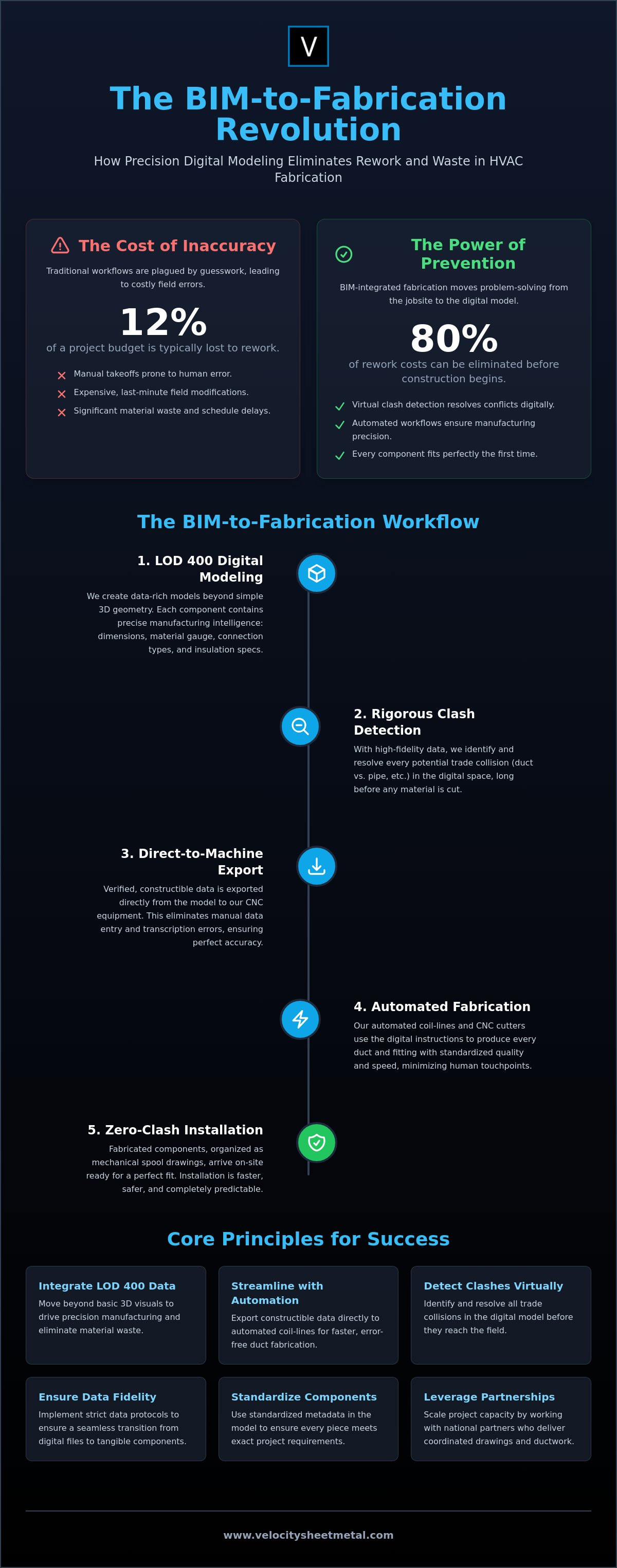
Rework typically drains up to 12% of a project budget, yet 80% of those costs can be eliminated before your team even arrives on site. In 2026, the difference between a profitable contract and a logistical nightmare lives in the digital model. You've likely felt the sting of trade collisions that force expensive, last-minute field modifications. Implementing rigorous BIM clash detection for HVAC fabrication ensures that every duct, hanger, and fitting fits the first time. It's about moving from guesswork to a controlled manufacturing environment.
We know you need more than just pretty 3D pictures; you need a workflow that drives production. This guide shows you how to master the transition from digital design to precision fabrication while cutting material waste to the bone. We'll explore the move from automated spooling to zero-clash installations. You'll learn how to leverage the latest information management standards to keep your project timelines predictable and your shop floor running at peak capacity. It's time to bridge the gap from a digital file to a tangible, high-quality product.
Key Takeaways
- Integrate LOD 400 data to move beyond basic 3D visuals and drive precision manufacturing that eliminates material waste.
- Streamline production by exporting constructible data directly to automated coil-lines for faster, error-free duct fabrication.
- Utilize BIM clash detection for HVAC fabrication to identify and resolve trade collisions virtually before they reach the field.
- Implement high-fidelity data protocols to ensure a seamless transition from digital design files to tangible mechanical components.
- Scale project capacity through a national partner that delivers BIM-coordinated spool drawings and standardized ductwork to any jobsite.
What is BIM for Sheet Metal Fabrication?
Building Information Modeling (BIM) is the digital DNA of the modern shop floor. For sheet metal fabricators, it is far more than a 3D visualization tool; it's a data-rich environment where every duct, fitting, and flange contains specific manufacturing intelligence. We move past simple geometry to create a comprehensive database that dictates exactly how metal is cut, bent, and assembled. This shift from "design intent" to "constructible data" is what separates a profitable project from a logistical disaster. In 2026, the standard is no longer just drawing lines, it's about building the project virtually before a single sheet of galvanized steel enters the coil-line.
The most critical advancement in this workflow is the integration of LOD 400, or Level of Development 400. While a standard design model shows where a duct might go, an LOD 400 model shows exactly how it's built. It includes precise dimensions, connection types, and hanger locations. This high-fidelity data allows for BIM clash detection for HVAC fabrication to happen with surgical precision. If the model is accurate to the millimeter, we can identify every trade collision in the digital space, ensuring that the physical components fit perfectly once they arrive at the jobsite.
The Core Components of a Fabrication-Ready Model
A fabrication-ready model prioritizes metadata over simple shapes. While the geometry shows the path, the metadata carries the specifications: material gauge, insulation requirements, and pressure classes. We use this information to generate mechanical spool drawings, which act as the final assembly instructions for the shop and the field. Standardizing these specifications within the digital model ensures that every piece of ductwork produced on our automated coil-line meets the exact requirements of the project. It's a methodical approach that replaces manual interpretation with automated accuracy.
Why Traditional Workflows are Failing Modern Projects
The days of translating paper blueprints to the field are over. Traditional workflows rely on manual takeoffs, which are the primary bottleneck in 2026 construction schedules. These manual processes are prone to human error, leading to inaccurate material orders and significant waste. When data is fragmented, errors aren't discovered until a crane is idling on the street and a duct won't fit. This "paper-to-field" lag creates cost leakage that most contractors can no longer afford. By utilizing BIM clash detection for HVAC fabrication, we eliminate the guesswork. We stop reacting to field problems and start preventing them through synchronized digital-to-physical workflows.
The BIM-to-Fabrication Workflow: From Digital Model to Machine
Software developers often treat the "export" button as the finish line. In reality, it's just the start of the manufacturing cycle. The model-to-machine bridge is the essential link that translates a virtual coordinate into a physical cut. By the time data reaches our shop floor, BIM clash detection for HVAC fabrication has already scrubbed the design for errors. This means the digital file we feed into our CNC equipment is a verified roadmap, not a rough suggestion. We maintain strict tolerances from the virtual model to the finished part by using direct digital-to-CNC translation. This removes the risk of human transcription errors and ensures that what was designed is exactly what gets built.
The transition from digital concept to physical product must be surgical. We don't just look at the geometry; we look at the constructible data. This involves exporting specific metadata that tells our machines exactly how to handle different material gauges and pressure classes. It's a methodical progression that turns a complex 3D model into a series of executable commands for our automated equipment.
Automated Coil-Line Integration
Speed defines the modern construction schedule. Our automated coil-line for rectangular duct production is driven directly by constructible BIM data. By feeding this information into our production software, we reduce human touchpoints to a minimum. This increases production speed while ensuring every piece of ductwork meets a standardized quality level across high-volume runs. It's a controlled environment. The software calculates the exact dimensions, the machine pulls the coil, and the result is a precision-formed part ready for assembly. This level of automation is why large-scale projects, which often follow standards similar to BIM for Infrastructure, rely on digital-first fabrication to maintain pace.
CNC Laser Cutting and Precision Bending
Not every HVAC component is a straight run. Custom fittings and complex geometries require specialized handling. Our BIM files optimize nesting patterns for custom laser cutting, which significantly reduces material waste. This data flows seamlessly into our precision laser cutting services, allowing us to produce intricate components with high repeatability. When you prioritize BIM clash detection for HVAC fabrication during the coordination phase, the data sent to the CNC laser is already optimized for field installation. Once cut, digital data drives our CNC press brake for accurate bending. Every angle is calculated in the model and executed on the machine with absolute precision.
BIM Clash Detection for HVAC Fabrication: Eliminating Field Errors
The jobsite is the most expensive place to find a design flaw. Virtual trade coordination moves the discovery phase from the field to the digital model, ensuring we find every conflict before the crane arrives. By the time we start coil line duct fabrication, every duct path has been validated in a 3D environment. This proactive approach reduces field rework, which typically drains between 5% and 12% of a total project budget. Utilizing BIM clash detection for HVAC fabrication allows us to resolve these issues during the coordination phase. Industry benchmarks for 2026 show that this process can reduce rework costs by 60% to 80%. It's a methodical way to protect your margins and keep your timeline predictable.
Precision in the model translates directly to jobsite safety and material logistics. When we eliminate the need for field modifications, we also eliminate the hazards associated with on-site cutting and grinding. We ship exactly what fits, in the precise order your team needs it. This lean approach to logistics ensures that the jobsite remains organized and that material waste is kept to an absolute minimum. We aren't just delivering metal; we're delivering a verified installation sequence.
Hard, Soft, and Workflow Clash Detection
We categorize clashes into three distinct types to ensure comprehensive coordination. Hard clashes are physical collisions where ductwork intersects with structural steel or plumbing. Soft clashes involve clearance violations that might block maintenance access or violate building codes. Workflow clashes identify sequencing conflicts where the installation of one trade prevents the efficient progress of another. Solving all three virtually ensures that the physical installation is seamless and fast.
Precision Curb Adapters and Spooling
Generic BIM definitions often ignore specialized components like curb adapters. When you're replacing an existing Rooftop Unit (RTU), the transition must be perfect. We use BIM-level accuracy to design custom curb adapters that match the existing roof footprint and the new unit's supply and return locations simultaneously. This precision is captured in our mechanical spool drawings. These drawings act as a step-by-step assembly guide for the field team. By providing pre-coordinated components, we significantly reduce field labor costs. The installer isn't solving a puzzle. They're executing a verified plan with surgical precision.

Best Practices for Implementing a BIM-Integrated Strategy
Transitioning from a digital file to a tangible product requires more than just high-end software. It demands a rigid framework that connects every project stakeholder. Success in 2026 is defined by how well you move from a loose design intent to a strict manufacturing protocol. Without clear standards, your 3D model is just a drawing. With them, it becomes a production engine. Partnering with a BIM integrated fabrication shop ensures that your digital data translates perfectly to the shop floor. This partnership bridges the gap between the design office and the automated coil-line.
By prioritizing BIM clash detection for HVAC fabrication, you move from reactive field fixes to proactive shop-floor precision. This shift requires a commitment to data hygiene and team-wide training. Your shop and field teams must be equally comfortable interpreting a digital model. When everyone speaks the same digital language, the risk of miscommunication evaporates. It's about building a culture of accuracy that starts in the model and ends at the installation.
Phase 1: Standardization and Data Hygiene
We set LOD 400 as the baseline for all fabrication-ready models. This level of development provides the granular detail needed for hangers, joints, and seams. You must also standardize naming conventions for all mechanical spooling services. This keeps the shop and the field in sync throughout the project lifecycle. Software interoperability is the backbone of this phase. Whether your team uses Revit or Navisworks, the data must flow without friction. We focus on clean data exchange to ensure our CNC equipment receives perfect instructions every time.
Phase 2: Virtual Coordination and Validation
Weekly coordination meetings are the heartbeat of a successful project. This is where we execute BIM clash detection for HVAC fabrication alongside all other trades. We identify collisions between ductwork and structural steel before they become expensive field problems. Every shop drawing is validated against the master coordination model to ensure total alignment. We only finalize and release spool drawings to production after the model is 100% clash-free. This methodical validation process ensures that every component shipped to the jobsite is guaranteed to fit.
Scaling Production with a National BIM Fabrication Partner
Local fabrication shops often struggle with the complexity of multi-state rollouts. When your project spans several regions, you need a partner who can maintain the same level of precision in every market. We act as the authoritative bridge between your design team and the final delivery, ensuring that the digital-to-physical transition is seamless regardless of the jobsite location. By centralizing production, we apply BIM clash detection for HVAC fabrication at the source. This ensures that every component shipped meets the exact specifications of the master model, eliminating the variables that typically plague decentralized fabrication. We leverage 50+ years of combined industry experience to handle the most complex mechanical requirements with industrial pragmatism.
The ability to scale depends on trust in the data. Because we use a single, verified digital model to drive our automated equipment, we can guarantee standardized quality for national accounts across the US. This methodical approach removes the risk of "regional variations" in duct quality. We ship BIM-ready ductwork directly to your jobsite, synchronized with your installation schedule to keep the field team moving at peak velocity.
Consistency Across Multi-State Projects
National accounts require a manufacturing partner who can reduce administrative overhead. Working with a single, tech-savvy fabrication partner simplifies your procurement process and ensures uniform production standards for every facility in your portfolio. We move your project from initial concept to final delivery using a streamlined workflow that prioritizes speed and accuracy. This consistency is vital for nationwide rollouts where even a minor error in a spool drawing can lead to massive cost leakage across multiple sites. Our team manages the data hygiene and software interoperability so your project managers don't have to.
On-Demand Production and Logistics
Large-scale projects demand rapid turnaround times for both standard ductwork and custom components. Our shop is optimized for high-volume production, from automated coil-line rectangular duct to custom laser-cut parts. We use strategic shipping and logistics to ensure that your materials arrive exactly when the model says they should. This precision in delivery is backed by our internal BIM clash detection for HVAC fabrication protocols, which verify every fitting before it leaves our facility. Velocity Sheet Metal is the essential choice for national BIM coordination because we combine 50 years of manufacturing expertise with the latest digital-to-physical automated technologies to guarantee a zero-clash installation on every jobsite.
Precision Fabrication Starts with the Model
The transition from a digital file to a physical product shouldn't be a gamble. By integrating LOD 400 data with automated manufacturing, you transform sheet metal into a precision-engineered asset. You've seen how virtual coordination and BIM clash detection for HVAC fabrication eliminate the rework that traditionally drains project profits. It's about moving from a reactive mindset to a controlled, methodical production line that guarantees a zero-clash installation on every jobsite.
Velocity Sheet Metal acts as the essential bridge between your design team and the final delivery. We leverage 50+ years of combined experience and high-speed automated coil-line production to deliver standardized quality for national accounts. Our national shipping capabilities ensure that your BIM-ready ductwork arrives on time and ready for assembly. Don't let manual errors dictate your project's success. It's time to embrace a workflow built for the speed of 2026 construction.
Request a Quote for BIM-Integrated Fabrication and start building with industrial precision today.
Frequently Asked Questions
What is a BIM to fabrication workflow?
A BIM to fabrication workflow is the methodical translation of a digital 3D model into machine-executable instructions. It connects the design office directly to the shop floor by stripping away manual data entry and human interpretation. This process ensures that the transition from a digital file to a physical product is seamless, fast, and accurate. It's the essential bridge for modern, high-volume manufacturing.
How does BIM clash detection improve HVAC fabrication accuracy?
BIM clash detection for HVAC fabrication improves accuracy by identifying every physical trade collision before the materials arrive on site. We use the digital model to scrub the design for conflicts between ductwork, structural steel, and plumbing. This proactive validation ensures that every component is built to fit the first time. It eliminates the cost leakage typically caused by field rework and project delays.
What is the difference between CAD and BIM in HVAC production?
CAD provides basic geometry and lines, but BIM provides a data-rich environment where every component carries manufacturing intelligence. In HVAC production, BIM includes material gauges, pressure classes, and connection details that CAD simply lacks. This metadata allows us to automate production and coordinate installations with surgical precision. BIM is a database of constructible information, not just a digital drawing.
Can BIM models be used directly to drive CNC machinery?
BIM models serve as the direct input for CNC machinery, including laser cutters and press brakes. We export constructible data that our production software translates into precise machine code. This eliminates the risk of transcription errors and ensures that project tolerances are maintained from the virtual model to the finished part. It's a high-speed, digital-to-physical bridge that maximizes production efficiency.
What level of development (LOD) is required for fabrication?
Level of Development (LOD) 400 is required for a model to move from design intent to the fabrication floor. At LOD 400, the model contains the specific manufacturing and assembly data needed for our automated coil-lines. This high-fidelity data is what makes BIM clash detection for HVAC fabrication effective. Anything less than LOD 400 requires manual interpretation, which introduces the risk of field errors and material waste.
How does BIM coordination reduce material waste on jobsites?
BIM coordination reduces material waste by allowing for precise nesting and error-free production. We use the coordinated model to calculate exact material requirements, which prevents over-ordering and maximizes the yield from every coil of steel. By identifying errors virtually, we also avoid the waste of fabricating and shipping parts that cannot be installed due to trade collisions. It's lean manufacturing in action.
What are mechanical spooling services?
Mechanical spooling services involve dividing complex duct systems into manageable sections, or spools, for shop fabrication and field assembly. Each spool is assigned a unique identifier and a corresponding shop drawing. This process allows us to pre-assemble components in a controlled shop environment. It reduces on-site labor and simplifies the logistics of delivery, ensuring the right parts arrive at the right time.
Does Velocity Sheet Metal ship BIM-coordinated ductwork nationwide?
Velocity Sheet Metal provides nationwide shipping for all BIM-coordinated ductwork and custom fittings. We maintain standardized quality for national accounts, ensuring that every project receives precision-engineered components regardless of its location. Our logistics team is optimized for high-volume delivery, keeping your project on schedule. We act as your reliable manufacturing partner for large-scale rollouts across the United States.