Automated Duct Fabrication: The 2026 Guide to High-Volume HVAC Efficiency
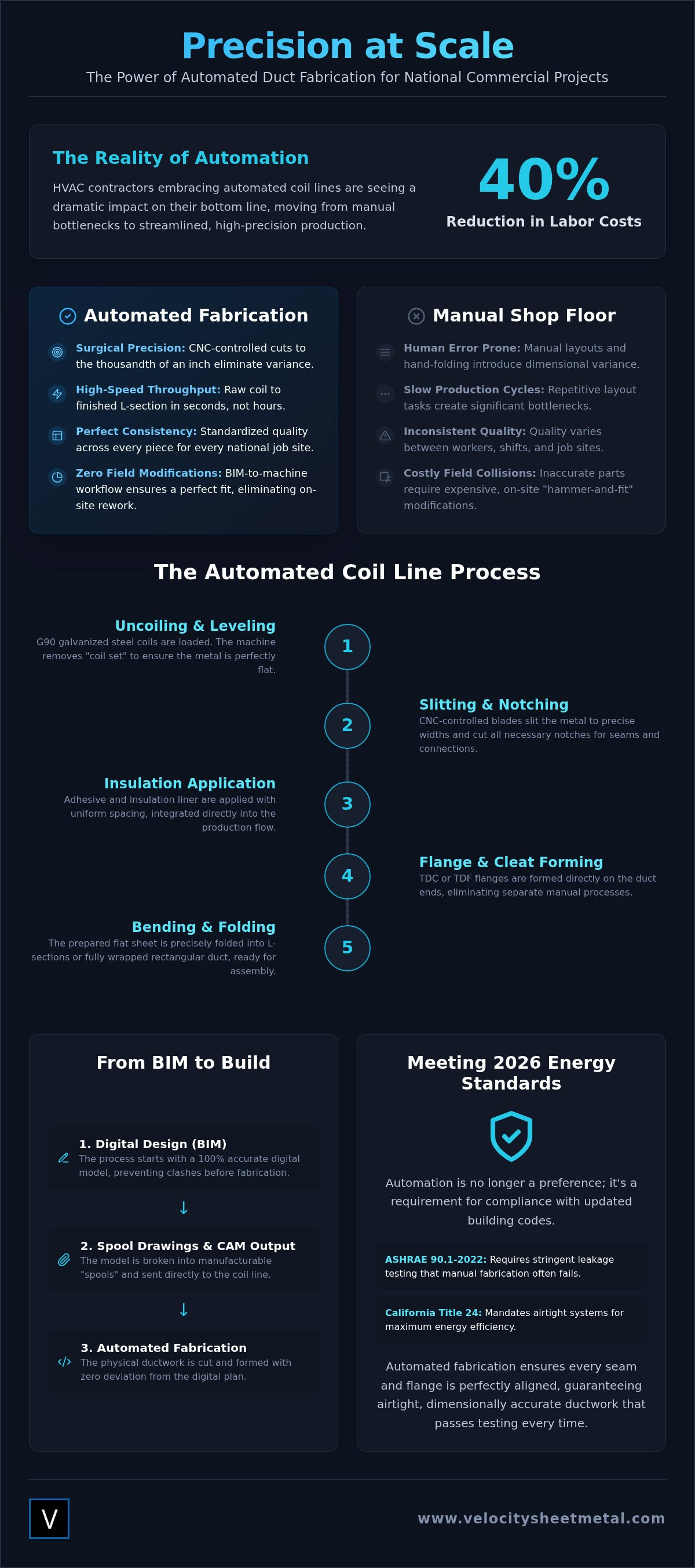
A 40% reduction in labor costs isn't just a target. It's the reality for HVAC contractors who have moved away from manual shop floors to embrace automated duct fabrication. You know the drill. A single inaccurate manual measurement leads to a field collision. That collision leads to expensive on-site modifications and a blown schedule. When you're managing national commercial projects, you can't afford to wait on local shops with limited capacity. It's time to demand more from your supply chain.
You've felt the pressure of rising costs and the sting of field errors; we're here to show you a more precise path forward. This guide explores how automated coil line fabrication ensures precision ductwork delivered at scale for national commercial projects. You'll discover how to leverage BIM coordination to achieve zero field-modification requirements and faster installation times. We'll break down the latest 2026 standards for energy efficiency, including the impact of ASHRAE 90.1, and explain how to maintain standardized quality across every job site in your portfolio. From the initial digital concept to the final physical delivery, see how automation bridges the gap between your design and a finished, high-performance system.
Key Takeaways
- Learn how CNC-controlled workflows transform raw steel coils into finished rectangular sections with surgical precision.
- Understand the production throughput advantages of automated duct fabrication over traditional manual layout methods.
- Discover how digital-to-physical workflows and spool drawings prevent field collisions before the first piece of metal is cut.
- Identify the logistics strategies that allow high-volume shops to maintain standardized quality across multiple national job sites.
- See how moving fabrication off-site to a specialized facility eliminates manual bottlenecks and accelerates your project timeline.
What is Automated Duct Fabrication?
Precision starts at the coil. Automated duct fabrication is the process of using computer-controlled coil lines to transform raw steel into finished rectangular duct with minimal human intervention. Traditional shops rely on manual layout and hand-folding, which introduces variance and slow production cycles. Modern facilities have replaced these bottlenecks with integrated CNC workflows that move material from a raw roll to a finished L-section in seconds.
By 2026, the demand for precision has moved from a preference to a requirement. Updated building codes, including California's Title 24 and ASHRAE 90.1-2022, mandate stringent leakage testing for HVAC duct systems. Manual fabrication often fails these tests due to inconsistent seams and flange alignments. Automation removes this risk by adhering to strict HVAC ductwork fabrication standards, ensuring every piece is airtight and dimensionally accurate.
Key Components of an Automated Coil Line
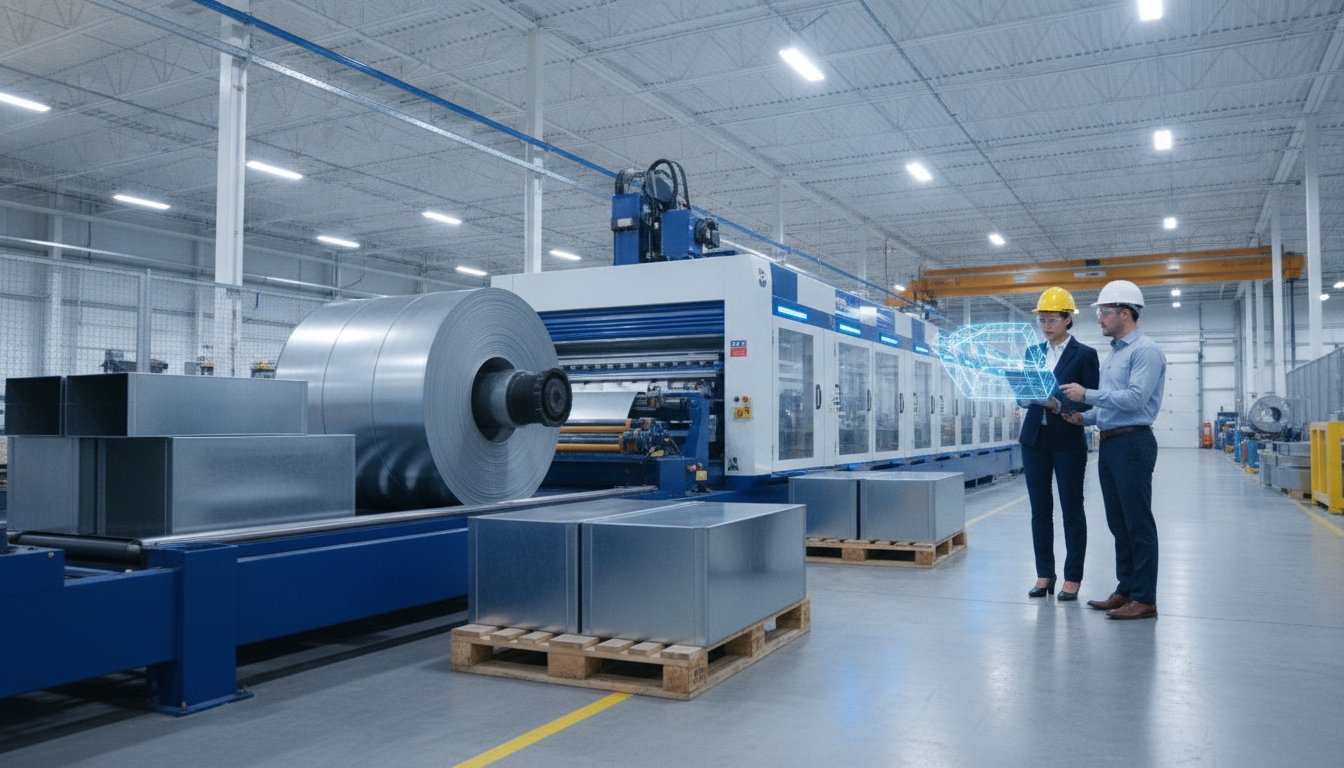
A high-volume coil line is a synchronized system designed for speed. It begins with multiple uncoilers that manage heavy G90 galvanized steel rolls, allowing for quick material changes between gauges. The leveling and slitting section then takes over, removing coil set to ensure the metal is perfectly flat before cutting it to precise widths. This precision is vital for the next stages of assembly.
The system also includes automated notching and punching units that prepare the metal for seams and connections. Finally, the cleat and flange forming stations create TDC or TDF flanges directly on the duct ends. This integrated approach eliminates the need for separate, manual flanging processes. The result is a product that is ready for the field the moment it leaves the line.
The Move Toward Industrialized Construction
Automation is the backbone of the current shift toward modular and pre-fabricated construction. By using automated duct fabrication, contractors can significantly reduce their man-hour per pound ratio. You're no longer paying for skilled labor to perform repetitive layout tasks. Instead, that labor is redirected to high-value assembly and installation. This efficiency is what allows national accounts to scale their operations without a linear increase in costs.
Beyond speed, automation provides a level of standardization that manual shops can't match. Whether you're managing a single site or a dozen projects across the US, the quality remains identical. This consistency bridges the gap between a digital BIM model and a collision-free field installation. It ensures that every piece of ductwork fits exactly as designed, every single time.
The Mechanics of Coil Line Duct Production
The coil line is a continuous loop of industrial productivity. It doesn't just cut metal; it engineers it. From the moment the uncoiler begins to spin, the material undergoes a series of high-speed transformations. The process starts with leveling to remove coil set, followed by precision slitting and notching. These CNC-driven steps prepare the exact dimensions for every joint, eliminating the need for manual layout and the errors that come with it. By the time the metal reaches the folder, it is ready to be shaped into L-sections or fully wrapped rectangular duct.
High-performance commercial projects often require internal lining for thermal or acoustic insulation. Modern automated duct fabrication lines integrate insulation application directly into the production flow. The machine applies adhesive and pins the liner with uniform spacing, ensuring a bond that manual spraying simply cannot replicate. This seamless integration keeps the line moving at peak velocity without the bottlenecks of a separate lining station.
Precision is the death of the "hammer-and-fit" culture. In the past, field crews expected to force pieces together on-site. Automation changes that. When every notch and seam is cut to a thousandth of an inch, joints slide together as intended. Field teams spend their time hanging duct rather than modifying it. This is where BIM for ductwork fabrication proves its value; the digital model dictates the physical cut, ensuring 100% accuracy from shop to ceiling.
Material Handling and Gauge Versatility
Managing different gauges is a seamless transition in a high-volume shop. We process various thicknesses of galvanized steel, from 26-gauge to 16-gauge, with zero recalibration downtime. This versatility is essential for industrial ventilation where pressure requirements vary by floor or system type. Advanced nesting software works behind the scenes to optimize every square inch of the steel coil. It minimizes scrap metal waste and maximizes your procurement budget by getting more duct out of every ton of steel.
Automated Seaming and Jointing
Seam selection is critical for system integrity. Pittsburgh locks remain the industry standard for high-pressure systems due to their superior strength. For low-pressure runs, Snap-lock seams offer a faster assembly alternative. Machine-formed seams ensure consistent SMACNA pressure class ratings across the entire production run. This level of coil line duct fabrication integrates perfectly with secondary fitting production, creating a unified workflow for the entire project. If you are ready to eliminate manual bottlenecks, Velocity Sheet Metal is prepared to deliver the precision your project demands.
Automated vs. Manual Fabrication: Speed and Precision Analysis
Manual sheet metal work is a craft, but crafts don't scale at the pace of modern commercial construction. In a traditional shop, a master fabricator spends hours on layout, cutting, and folding. This manual approach is vulnerable to fatigue and human error. In contrast, automated duct fabrication operates with a relentless, programmatic speed that manual benches simply cannot match. It's the difference between a custom workshop and a high-velocity production engine. Choosing automation isn't just about speed; it's about risk management.
The current labor market has made this shift a necessity. With skilled sheet metal workers in short supply, relying on manual labor to meet aggressive 2026 project deadlines is a high-risk strategy. Automation mitigates this labor shortage by shifting the heavy lifting to CNC-controlled systems. This allows your skilled team to focus on complex fittings and BIM-led coordination rather than repetitive straight-duct production. You're buying capacity, not just metal.
Production Throughput and Lead Times
Speed is the primary currency of high-volume HVAC. An automated coil line can produce up to 10x the volume of a manual bench shop in the same timeframe. This massive increase in throughput directly translates to shorter lead times for national commercial accounts. When a project requires thousands of feet of ductwork on a tight schedule, manual shops often become the primary bottleneck. Automation eliminates this delay, moving material from the shop to the job site with surgical efficiency. It provides:
- Reduced lead times for massive industrial ventilation projects.
- Predictable delivery schedules for multi-site national rollouts.
- The ability to scale production without increasing shop floor headcount.
Tolerance and Fitment Accuracy
Precision is not just about aesthetics; it's about the "hidden costs" of air leakage and field modifications. Manual fabrication often results in slight variances that compound over a long run. Machine-formed ductwork achieves +/- 1/32" tolerances consistently, piece after piece. This level of accuracy is essential for meeting the latest SMACNA duct construction standards, which emphasize tighter seals and higher energy efficiency. Machine-formed flanges create a superior, airtight connection that manual folding can't replicate. When the duct arrives on-site, it fits the first time. This eliminates the need for field "hacking" or expensive modifications, ensuring that the system performs exactly as engineered while keeping your installation costs predictable.
Digital-to-Physical: Integrating BIM and Spooling
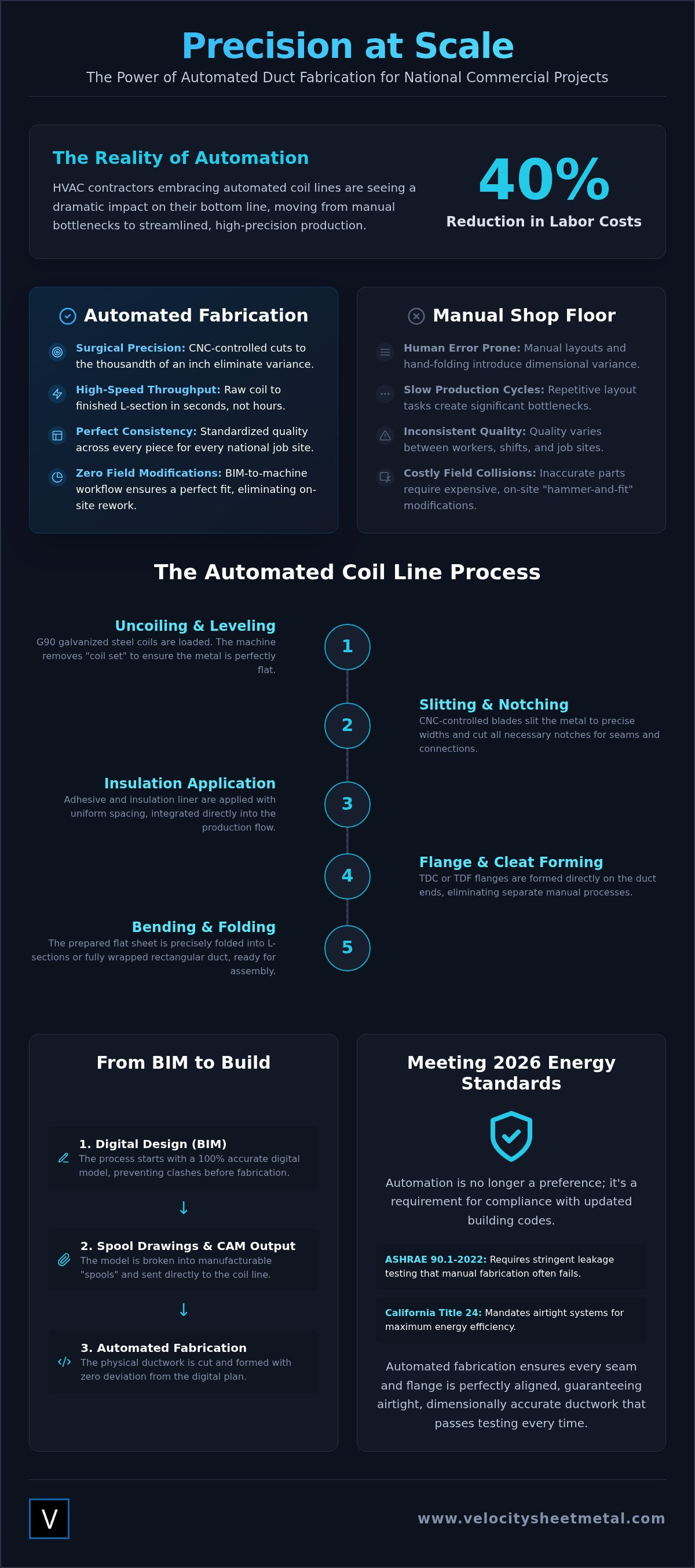
The transition from a digital file to a physical product is the most critical phase of any HVAC project. In 2026, the industry has moved beyond static blueprints. Modern automated duct fabrication relies on a direct data link between the BIM model and the shop floor. This digital-to-physical workflow ensures that the precision engineered in the virtual environment is perfectly replicated in the sheet metal. When you integrate BIM for sheet metal fabrication, you're essentially providing the coil line with a surgical roadmap.
This integration starts with software like Revit and SysQue. Data flows directly from these platforms to the CNC controllers. There's no manual re-entry of dimensions. No room for transcription errors. Every joint, notch, and flange is dictated by the coordinated model. This process allows for the creation of spool drawings that pre-plan every single joint before the uncoilers even start to spin. It's a methodical approach that replaces guesswork with industrial certainty.
Mechanical Spooling and Labeling
Spooling is about logistics as much as it is about manufacturing. By breaking down complex rectangular duct runs into manageable sections, we simplify the entire installation process. This streamlined system supports the speed of automated duct fabrication by ensuring the field can keep up with the shop's output. Our system includes automated labeling that marks every piece with its specific location in the building. This reduces on-site staging and storage requirements significantly. Field crews don't waste time hunting for parts. They follow the spool map.
Eliminating Field Collisions
The true ROI of a digital workflow is found in the absence of problems. We use BIM clash detection for HVAC fabrication to identify structural or multi-trade conflicts before production begins. If a duct run hits a plumbing line or a structural beam in the model, we fix it digitally. This prevents costly physical rework and the "hacking" mentioned in previous sections. Coordination allows us to standardize duct sections into a "plug-and-play" format. This predictability is why national accounts trust us with their most complex multi-trade commercial projects.
If you're ready to bridge the gap between your digital design and a tangible, high-performance product, partner with Velocity Sheet Metal for your next coordinated project.
Procuring Automated Ductwork for National Accounts
Managing a multi-state construction portfolio requires a level of consistency that local shops simply cannot provide. For national accounts, the priority shifts from proximity to predictability. You need a partner who can guarantee that the ductwork installed in a Seattle warehouse is identical to the system in a Miami distribution center. Automated duct fabrication is the engine that makes this standardization possible. By centralizing production in a high-volume facility, you eliminate the regional variance that often plagues large-scale HVAC rollouts.
Scaling your operations depends on a reliable, tech-forward supply chain. When you rely on a network of small, manual shops, you're at the mercy of their varying capacities and lead times. Evaluating a fabricator's capacity for large scale ductwork production requires looking beyond the machines. You need to see a workflow that handles the from-to journey from digital file to flatbed truck. A shop that can't manage the logistics of multi-state delivery is just as much a bottleneck as a shop with manual folders. We've optimized our entire facility for this high-volume throughput. This ensures your procurement department isn't chasing down shipments or questioning quality variances between job sites.
Standardizing Quality Nationwide
Quality control shouldn't be a variable. Whether you're ordering RTU curb adapters or thousands of feet of straight duct, every component must meet the same rigorous specification. Our facility serves national facility managers by providing a repeatable, machine-certified product. We leverage national shipping networks to ensure on-time delivery to job sites across the continental US. This logistics capability ensures that your project timeline stays intact regardless of the local labor market's limitations. We move your project from the drafting table to the site with surgical precision.
The Velocity Advantage in Automation
Velocity Sheet Metal is built for the demands of the modern contractor. Our automated duct fabrication line is just one part of a comprehensive manufacturing ecosystem. We combine our high-speed coil line with precision CNC laser cutting to handle complex fittings and specialized components with the same efficiency as straight duct. This dual capability allows us to serve as a high-capacity OEM partner for contractors nationwide. We don't just ship metal. We deliver a coordinated, ready-to-install system that arrives on your site precisely when needed. Get a quote for your next high-volume project. and experience the efficiency of a truly automated supply chain.
Scale Your HVAC Operations with Industrial Precision
Efficiency in 2026 is no longer optional; it's the baseline for success in a high-volume commercial market. We've explored how automated duct fabrication serves as the essential bridge between your digital BIM coordination and a collision-free field installation. By eliminating manual layout errors and the traditional "hammer-and-fit" culture, you secure faster installation times and zero field-modification requirements. The shift from local shop limitations to a centralized, high-capacity production engine is how national accounts maintain standardized quality across every job site.
Velocity Sheet Metal brings 50+ years of combined industry experience to your supply chain. Our BIM-integrated production workflow ensures that every piece of metal matches your model with surgical accuracy. We back this technical capability with national shipping, ensuring your projects stay on schedule regardless of the local labor market's constraints. Don't let administrative delays or shop bottlenecks stall your momentum. It's time to partner with an expert operator ready to deliver at scale. Request a Quote for Automated Duct Fabrication today. Let's get your next project moving.
Frequently Asked Questions
What is the primary benefit of automated duct fabrication?
The primary benefit is the elimination of manual bottlenecks through surgical precision and industrial speed. Automated duct fabrication reduces labor costs while ensuring every section is airtight and dimensionally accurate. This efficiency moves your project from the shop to the ceiling faster than traditional methods allow. It provides a level of consistency that's essential for meeting modern energy codes and aggressive construction schedules.
How does a coil line differ from traditional manual sheet metal fabrication?
A coil line transforms raw steel into finished rectangular sections in one continuous, CNC-controlled flow. Traditional manual fabrication relies on separate layout, cutting, and folding stages performed by hand at a bench. While manual shops are limited by the speed of their labor, a coil line delivers high-volume throughput with zero variance. This shift from human effort to machine precision ensures repeatable quality across every joint.
Can automated duct fabrication handle custom sizes and transitions?
Yes, automation handles complex transitions and custom sizes through integrated CNC laser cutting and press brake bending. While the coil line excels at straight rectangular runs, our secondary automated systems process custom fittings with the same speed and accuracy. This creates a unified production environment where custom work doesn't slow down high-volume output. You get the benefits of mass production for every unique piece in your system.
Does automated fabrication meet SMACNA standards?
Automated fabrication is engineered to meet and often exceed current SMACNA duct construction standards. Machine-formed Pittsburgh locks and TDC/TDF flanges provide a level of airtightness and seam integrity that manual work can't consistently replicate. This precision is critical for maintaining specific pressure class ratings and meeting 2026 energy efficiency requirements. Every piece of metal is cut and folded to exact specifications, ensuring field performance matches design.
How does BIM coordination integrate with automated duct production?
BIM coordination integrates directly with the shop floor through software like Revit and SysQue. Digital files drive the CNC machinery, moving data from the virtual model to the physical metal without manual re-entry. This "digital-to-physical" workflow ensures that every piece of automated duct fabrication fits exactly as planned. It identifies structural conflicts digitally to avoid costly field rework and collisions during the final installation phase.
What are the lead time advantages of using an automated fabricator?
Lead times are significantly reduced because automated lines produce up to 10x the volume of manual shops. This high-capacity throughput allows us to handle large-scale commercial projects that would overwhelm a traditional fabricator. By centralizing production and using optimized workflows, we move material quickly from the uncoiler to the flatbed truck. This speed is a strategic advantage for national accounts managing tight multi-state project schedules.
How does automated fabrication reduce material waste?
Automation reduces material waste through advanced nesting software that optimizes every square inch of the steel coil. The system calculates the most efficient layout for cuts and notches before the first sheet is processed. This minimizes scrap metal and maximizes your procurement budget. By getting more duct out of every ton of galvanized steel, we lower the overall material cost and environmental impact of your project.
Can automated ductwork be shipped nationwide for large-scale projects?
Yes, standardized ductwork is designed for national shipping and large-scale commercial rollouts. We serve contractors and facility managers across the US by providing consistent quality regardless of the project location. Our logistics network ensures that every RTU curb adapter and duct run arrives on-site exactly when needed. This nationwide reach allows national brands to maintain a single-source fabrication partner for all their multi-state requirements.